
Have any questions? Start a conversation with our team.
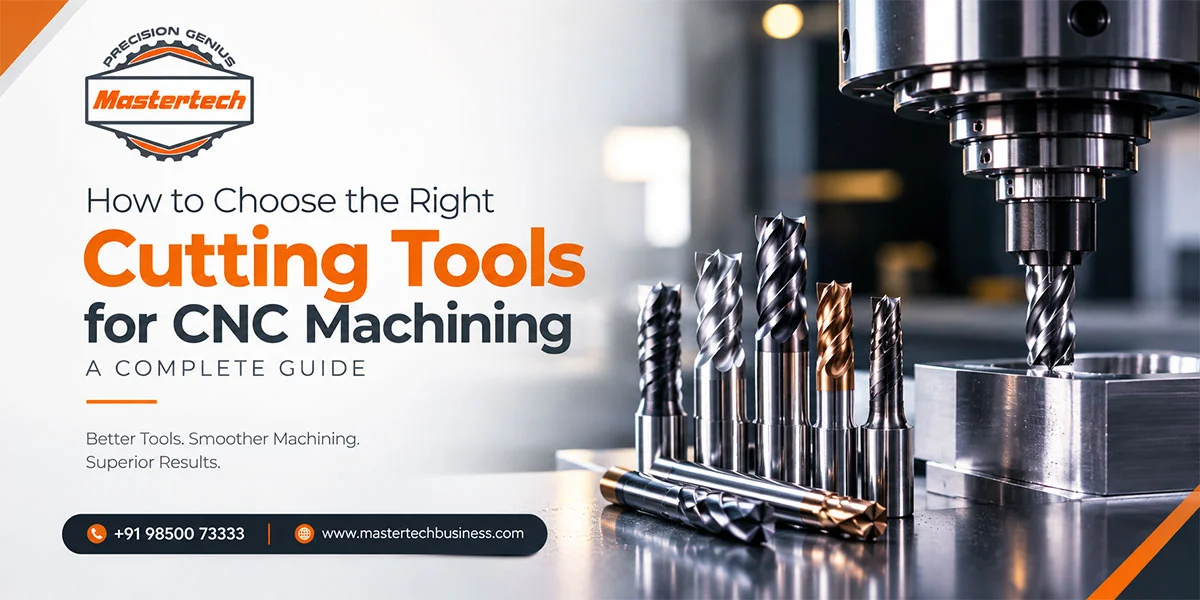
CNC machining demands precision, consistency, and the right tooling for every application. While the CNC machine, programming, and workholding setup are important, the cutting tool directly determines how effectively material is removed and how accurately the final component is produced.
Choosing a cutting tool is not simply about selecting the correct diameter. Workpiece material, machining operation, tool geometry, carbide grade, coating, machine capability, cutting parameters, and required surface finish all play an important role.
The right tool can help achieve stable machining, consistent dimensions, better surface finish, and predictable tool life. The wrong selection can lead to excessive wear, vibration, poor chip evacuation, tool breakage, and unnecessary production costs.
This guide by Mastertech Business Solutions Pvt. Ltd. explains the key factors to consider when selecting CNC cutting tools for different machining applications.
These decisions affect stability, surface finish, and cost per component. Below, we walk through each factor in detail so the wrong tool choice never becomes an avoidable production cost.
A cutting tool operates directly against the workpiece, making its design and condition critical to the machining process. An unsuitable tool may result in:
A properly selected tool, on the other hand, can provide more stable cutting and consistent machining performance. The objective is not simply to choose the hardest or most expensive tool — the goal is to match the tool with the material, operation, machine, and production requirements.
The first consideration when selecting a cutting tool should be the material being machined.
Aluminium, mild steel, stainless steel, cast iron, hardened steel, and other engineering materials behave differently during machining. Their hardness, toughness, abrasiveness, heat generation, and chip formation characteristics can all influence tool performance.
Before selecting a tool, consider:
A tool geometry that performs effectively on aluminium may not be the right choice for hardened steel. Material-specific tool selection is therefore essential for consistent results.
Get the right carbide grade and geometry recommended by Mastertech's tooling engineers, Pune.
Different CNC machining operations require different tool designs.
Common applications include:
For milling applications, end mills are commonly used for slotting, profiling, pocketing, and contouring. Drilling operations require drill geometries suited to the hole diameter, depth, material, and required tolerance.
Choosing the tool according to the actual machining operation helps ensure that the cutting geometry is appropriate for the job.
Tool material has a direct influence on rigidity, wear resistance, cutting performance, and potential tool life. For many precision CNC applications, solid carbide is preferred when high rigidity and consistent cutting performance are required.
Solid carbide tools can be suitable for:
However, carbide alone does not guarantee the desired result. Tool geometry, flute configuration, coating, cutting parameters, machine rigidity, and workpiece material must also be considered.
For applications requiring precision-engineered carbide tooling, you can explore Mastertech's range as a Solid Carbide Tools Manufacturer Pune.
| Tool Material | Rigidity | Wear Resistance | Typically Suited For |
|---|---|---|---|
| Solid Carbide | High | High | Precision, high-speed & small-diameter work |
| Carbide-Tipped | Moderate | Moderate–High | Larger tools, general-purpose milling |
| HSS (High-Speed Steel) | Lower | Lower | Lower-speed, cost-sensitive operations |
End mills are widely used in CNC milling for applications such as slotting, profiling, pocketing, contouring, and finishing.
The correct end mill depends on several factors.
Larger diameter tools generally provide greater rigidity, while smaller tools are useful for narrow slots, intricate features, and restricted machining areas. The selected diameter should provide the required accessibility without creating unnecessary deflection.
Flute count affects chip evacuation, cutting action, and machining performance. The appropriate flute configuration depends on the workpiece material and machining application. The tool should provide enough space for efficient chip removal while maintaining the required cutting performance.
Helix angle and cutting-edge geometry influence cutting forces, chip evacuation, vibration, and surface finish. Therefore, selecting an end mill should involve more than simply choosing a diameter.
For precision milling requirements, Mastertech provides a range of end mills as an End Mills Manufacturer India. The range includes solid carbide, corner radius, profile, micro, step, taper, roughing, 4-flute, and 6-flute end mills.
Drilling is another important CNC operation where tool selection can directly affect hole quality.
Before selecting a carbide drill, consider:
Carbide drills can be suitable for demanding applications where rigidity, wear resistance, dimensional accuracy, and consistent drilling performance are important.
The drill geometry must still match the application. For example, deep-hole drilling may require a different solution from a standard shallow-hole operation.
Mastertech Business Solutions Pvt. Ltd. offers precision drilling solutions as a Carbide Drills Manufacturer Pune, including solid carbide drills, through-coolant drills, step drills, centre drills, gun drills, and other specialized drilling solutions.
Tool geometry plays an important role in machining performance. Two tools made from the same basic material can behave differently because of variations in geometry.
Important factors include:
These characteristics influence cutting forces, chip evacuation, tool rigidity, vibration, and surface finish.
Tool overhang should also be considered. Excessive projection can increase deflection and vibration, particularly during precision machining.
Tool coatings can help improve wear resistance, thermal performance, and friction characteristics depending on the application. However, there is no single coating that is suitable for every machining condition.
Coating selection should consider:
The coating should therefore be considered as part of the complete tooling solution rather than as an isolated specification.
The capabilities of the CNC machine also influence tool selection.
The machine should be capable of achieving the required RPM for the selected tool and application.
Heavy material removal may require greater spindle power. The tooling strategy should be compatible with the available machine power.
A rigid machine and stable workholding setup can help reduce vibration and maintain dimensional consistency.
Tool-holder condition and runout are particularly important for precision applications.
Effective coolant delivery and chip evacuation can help control heat and prevent chips from interfering with the cutting process.
The tool, holder, machine, workholding, and cutting parameters should therefore be treated as one complete machining system.
Send us your drawing — our engineers will recommend the right tooling in one call.
Even a well-selected cutting tool can perform poorly when used with unsuitable machining parameters.
Important parameters include:
Incorrect parameters can cause excessive heat, premature wear, chipping, vibration, poor surface finish, or tool breakage.
Tool life should also be evaluated in relation to the complete production process. Instead of looking only at the purchase price of a tool, manufacturers should consider the overall cost per component, including tool changes, machining time, rejected components, and production interruptions.
The lowest-priced tool may not always provide the lowest overall machining cost. Tool life, consistency, and production performance should also be considered.
Different materials require different machining strategies. A tool that works well for one material may not be appropriate for another.
Excessive tool projection can increase deflection and vibration. Use the shortest practical tool configuration whenever the component geometry allows.
Tool specifications should match the spindle speed, power, rigidity, and tool holder available on the machine.
Carbide grade and coating are important, but tool geometry and application conditions are equally significant.
The machining operation, workpiece material, machine capability, tooling setup, and production requirement should all be considered together.
After understanding the machining requirement, the next step is choosing a tooling partner capable of supplying consistent products and suitable solutions.
When evaluating a manufacturer, consider:
If you're looking for a Cutting Tools Manufacturer Pune, factors such as manufacturing capability, product consistency, technical support, and application understanding can help you evaluate a suitable supplier.
For companies sourcing precision tooling across different regions, an experienced Cutting Tools Manufacturer India can provide access to a broader range of machining solutions.
Mastertech Business Solutions Pvt. Ltd. manufactures precision cutting tools using advanced 5-axis CNC grinding technology and carbide materials, with products serving applications across industries such as automotive, aerospace, defence, railways, die and mould, and engineering.
CNC machining applications can vary significantly depending on the component, material, tolerance, and production process.
A suitable tooling solution may involve:
When you're evaluating a CNC Cutting Tools Manufacturer Pune, look beyond individual products and consider whether the supplier can support the complete machining requirement.
For businesses sourcing tools across India, choosing a CNC Cutting Tools Manufacturer India with a suitable product range and application-focused approach can simplify tooling requirements.
There is no single cutting tool that performs equally well in every CNC machining application.
A practical selection process can be summarized as:
For example, an end mill selected for aluminium machining may require different geometry from an end mill used for hardened steel. Similarly, a carbide drill suitable for one hole depth may not be the ideal choice for a deeper drilling application.
Application-based selection allows manufacturers to evaluate tooling according to actual machining conditions instead of choosing a tool based only on price or a single specification.
Choosing the right cutting tool is an important part of achieving consistent CNC machining results.
From solid carbide tools and end mills to carbide drills and specialized tooling, the right selection depends on the workpiece material, machining operation, tool geometry, machine capability, and production requirements.
Rather than choosing a tool based only on price or one specification, manufacturers should evaluate the complete machining application.
A systematic approach to tool selection can help improve machining stability, dimensional consistency, surface finish, and overall tooling efficiency.
Connect with Mastertech Business Solutions Pvt. Ltd. to discuss your application and explore suitable tooling solutions.
