
Have any questions? Start a conversation with our team.
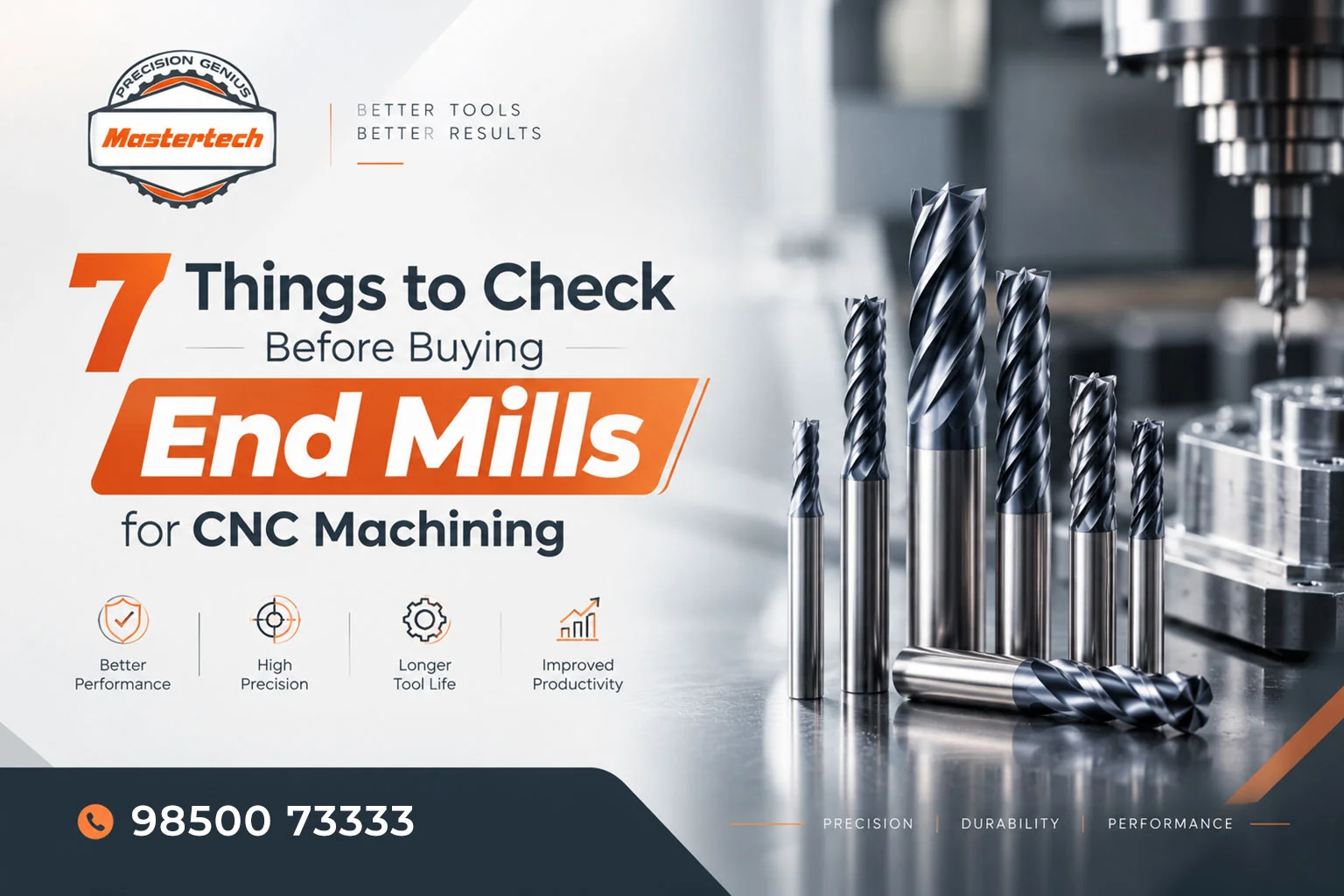
A good CNC machining job can quickly turn into a costly one when the wrong end mill is selected.
You may have a high-quality CNC machine, the right material, and experienced operators. But if the end mill is not suitable for the application, you can face poor surface finish, excessive tool wear, vibration, dimensional errors, or even unexpected tool breakage.
That is why buying an end mill should not be based only on price, diameter, or brand. The right end mill should match your workpiece material, machining operation, cutting parameters, machine capability, and production requirements.
At Mastertech, an end mills manufacturer in Pune supplying solid carbide tools across India, we see these selection mistakes every week. Here are 7 important things to check before buying end mills for CNC machining.
The first question should always be: "What material will this end mill cut?"
Aluminium, mild steel, stainless steel, cast iron, tool steel, hardened steel, and other alloys behave differently during machining. An end mill designed for aluminium may not deliver the same performance on hardened steel. Material hardness, chip formation, heat generation, and cutting resistance all influence tool selection.
Before buying, check:
A properly selected tool can improve cutting performance and help prevent premature tool wear.
Not all end mills are designed the same way. Flute count, helix angle, cutting edge geometry, core design, and corner configuration can significantly affect machining performance.
The ideal geometry for high-speed aluminium machining may be very different from what stainless steel needs. Depending on your application, you may need:
The right geometry helps control chip evacuation, cutting forces, surface finish, and tool life.
Diameter is one of the easiest specifications to check, but it is not the only one that matters. You should also consider the cutting length, overall length, and tool reach required for the job.
A longer tool may be necessary for deep pockets or hard-to-reach areas, but excessive tool length reduces rigidity and increases vibration. As a general rule: use the shortest tool reach that safely allows you to complete the operation.
Before purchasing, verify:
Not sure which size suits your job? Our end mills range covers standard sizes, and we can also make a tool from your drawing.
Send us your material, tool size and quantity. Mastertech's tooling engineers in Pune will suggest the right tool.
Modern coatings are designed to improve wear resistance, heat resistance, and tool life. However, one coating is not automatically best for every material or application.
The right coating depends on:
For demanding CNC applications, a suitably coated carbide end mill can help maintain consistent performance over longer production cycles.
Even the best end mill cannot perform properly if the machine parameters are unsuitable. Before purchasing, consider your machine's capabilities:
A high-performance tool used with inappropriate RPM or feed can produce excessive heat, vibration, or premature wear. This is why an experienced CNC cutting tools manufacturer in Pune looks at the complete machining application, not just the diameter. The same logic applies to tools from any carbide drills manufacturer in Pune: the machine and parameters decide the result as much as the tool itself.
A cheaper end mill is not always the cheaper option.
Tool A costs less but needs frequent replacement. Tool B costs more but gives longer tool life, faster machining, and more consistent performance. Which one actually saves money?
The real cost of an end mill includes:
Tool price + replacement frequency + machine downtime + machining time + rejected components
For production machining, tool life and productivity usually have a much bigger impact on overall cost than the purchase price. When comparing options from an End Mills Manufacturer Pune, ask about the expected application, recommended cutting parameters, and suitable tool grade instead of comparing price alone.
This is often overlooked. Two end mills may look almost identical, but their performance can differ widely depending on carbide quality, grinding accuracy, geometry consistency, coating quality, and inspection standards.
Mastertech is an ISO 9001:2015 certified cutting tools manufacturer in Pune. Our tools are ground on 5-axis CNC machines from premium German carbide rods, which helps maintain batch-to-batch consistency. When choosing an End Mills Manufacturer India, ask your supplier:
For companies that buy tools regularly, a reliable manufacturer gives far more consistency across production batches.
Before ordering your next end mill, ask these seven questions:
If you can answer these before purchasing, you are much more likely to select a tool that performs reliably in your actual machining environment.
End mills are small components, but they have a major impact on CNC machining performance. The right tool can help you achieve:
The right geometry and cutting conditions give a cleaner finished surface.
Consistent tooling helps hold required dimensions and tolerances.
Fewer tool changes and less downtime during production runs.
Better chip evacuation and more efficient machining cycles.
For precision machining, tool selection should be part of your machining strategy, not just a purchasing decision.
Mastertech Business Solutions is a solid carbide tools manufacturer in Pune making precision cutting tools for demanding industrial applications, including end mills, carbide drills, reamers, and profile tools. We serve automotive, aerospace, defence, railways, power and energy, and precision manufacturing industries.
The right combination of tool geometry, carbide grade, coating, and dimensions can make a real difference to your CNC machining results.
Send us your material, tool size, and quantity, and our tooling engineers will suggest a suitable tool.
