Have any questions? Start a conversation with our team.
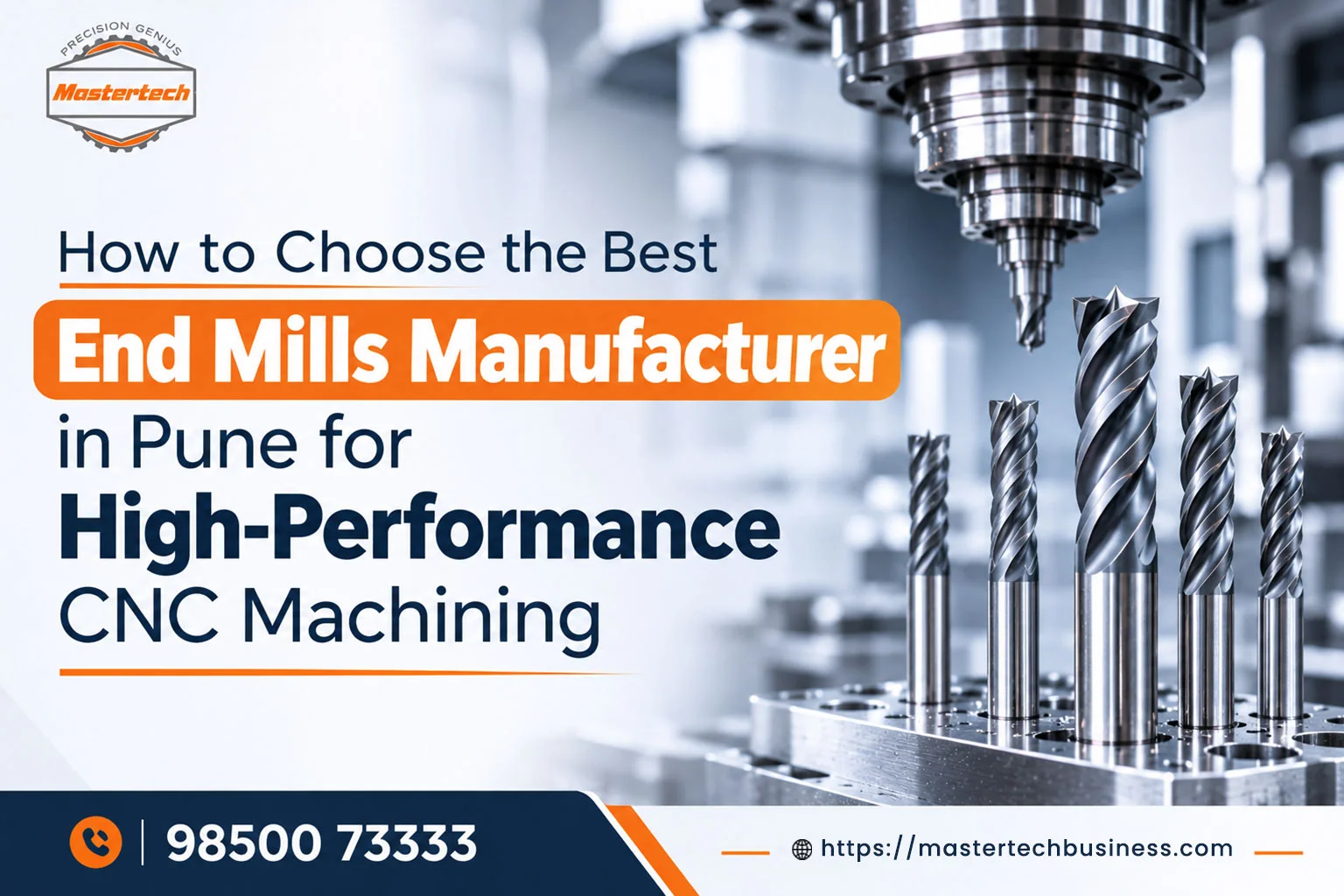
Finding an end mills manufacturer in Pune is easy. Choosing the right one is the hard part. Two suppliers can offer the same diameter and the same flute count, yet one tool runs three shifts without trouble while the other chips on the second day. The difference is rarely visible on the datasheet. It sits in the carbide, the grinding, the inspection and the support behind the tool.
This guide is written for machinists, purchase teams and production heads who buy end mills regularly. Instead of explaining how to read a tool drawing, it shows you how to judge the manufacturer: eight practical checks, the end mill range to expect, a fair way to test a new supplier, the red flags to avoid and exactly what to send with your enquiry. If you only want help matching a tool to a material, our guide on things to check before buying end mills covers that side.
An end mill is a small part of a CNC setup, but it controls almost everything that matters on the shop floor: how often the machine stops, how many parts are rejected and how stable the size stays through a batch. A weak tool wastes spindle time on tool changes, takes the operator's attention and produces components that fail inspection.
That is why experienced buyers look past the catalogue size and ask about the process behind the tool. The better question is not "who has this size available?" but "who can give me the same tool life and finish, again and again?"
Many suppliers listed under "end mills manufacturer Pune" are traders or resellers. That is not automatically bad. A trader can be useful for an urgent standard item. But for repeat production, special sizes or a tool problem that needs a real fix, it helps to know who actually grinds the tool.
| Point | Manufacturer | Trader / Reseller |
|---|---|---|
| Control over carbide and grinding | Selects the rod and grinds the tool in-house | Depends on whoever supplied the tool |
| Special or modified tools | Can change geometry or size to your drawing | Usually limited to what is available |
| Batch-to-batch consistency | Can hold a process and compare batches | May change source between orders |
| Fixing a tool-life problem | Can adjust the tool itself | Can only suggest a different tool |
| Best suited for | Regular volume and special requirements | One-time or urgent standard items |
A simple way to find out is to ask for a short factory visit or a video call from the grinding floor. A genuine manufacturer will usually be happy to show its process.
Use these checks as a scorecard while you shortlist two or three suppliers. Each one comes with a question you can put directly to the supplier.
An end mill is only as good as the carbide rod it is ground from. The grain size and cobalt content of the rod decide how hard, tough and heat resistant the tool will be. Rods from different sources can behave very differently, even when the finished tools look identical.
Flutes, helix, relief angles and the cutting edge are formed on a CNC grinder. A multi-axis grinder can form complex geometry in a single setup, which helps edge quality and repeatability. Ask about the grinding machines, the tolerance they hold and how the cutting edge is prepared before the tool leaves the shop.
Quality should be checked at stages, not only at the end. Look for a documented quality system such as ISO 9001, and for actual measurement of diameter, length and geometry on every batch. A supplier who can show an inspection report for your order is telling you the checking is real.
One good sample proves very little. What a production shop needs is the fifth order performing like the first. This is where a controlled process shows. If the supplier changes the rod source, the grinder setup or the coating partner between orders, tool life can change without any warning.
Few components are machined entirely with catalogue sizes. A good manufacturer carries a useful standard range and can also make special end mills from your drawing, such as a particular length of cut, a corner radius or a profile. If you machine dies, moulds or complex parts, also check whether ball nose and special tools are part of the range.
Coatings and edge preparation change how a tool behaves in a specific material. A supplier who recommends these for your job, instead of selling the same tool to everyone, is thinking about your results. Also ask what the supplier suggests when a tool does not reach the expected life.
A tool that arrives late stops a machine just as surely as a tool that breaks. Ask for realistic lead times for standard and special items, whether regular sizes are kept in stock and how dispatch is handled. For regular consumption, agree a delivery schedule instead of ordering at the last minute.
The best suppliers help before you buy. They ask about your material, operation, machine and tolerance, and they are willing to support a trial on your actual component. Pay attention to the questions a supplier asks you. If nobody asks about your application, the recommendation is probably a guess.
Share your material, drawing and quantity. Mastertech's tooling engineers will recommend a suitable end mill for your application.
A manufacturer worth shortlisting should supply the end mill types your shop actually uses, not just one or two popular sizes. Use this list to check whether a supplier's range matches your work:
General slotting, profiling and pocketing in a wide range of materials.
A stronger corner for finishing and heavier cuts, which helps protect the edge.
3D contouring and curved surfaces, common in die and mould work.
Made from your drawing when a standard size or profile does not fit the component.
Mastertech's solid carbide end mills are manufactured in Pune for CNC machining across industries, and our ball nose range covers contouring work. For requirements outside the standard range, see our special tools or the wider solid carbide tools range. Not sure which type suits your job? Share your material and operation, and our engineers will recommend one.
A trial on your own component tells you more than any brochure. Keep it simple and fair, so the result is something you can trust:
| What to Record | What It Tells You |
|---|---|
| Components per tool | How long the tool lasts in your real conditions |
| Size drift during the run | How well the tool holds its dimension as it wears |
| Finish at start and end | Whether edge quality stays stable through the tool's life |
| Edge condition after use | Whether wear is even or the edge chips and breaks |
| Second batch result | Whether the supplier delivers repeatable quality |
Share your results with the manufacturer. A good supplier will use them to suggest an adjustment in geometry, coating or parameters instead of simply asking you to try again. This is the same approach used for improving CNC machining accuracy: measure, record and adjust.
These warning signs are easy to spot if you know what to look for.
A complete enquiry gets you a faster and more accurate reply, and it shows the supplier that you know what you need. Send as many of these details as you can:
Even if you are not sure about some points, send what you have. A good manufacturer will fill the gaps by asking you the right follow-up questions.
Pune and its industrial belts, including MIDC Bhosari, Pimpri-Chinchwad and Chakan, are home to a large concentration of automotive and engineering component makers. That has two practical benefits for a buyer. First, a nearby manufacturer can visit your shop, see the component and the setup, and recommend a tool based on what is actually happening. Second, trial tools and feedback can move quickly, because the supplier is a short drive away instead of a courier shipment away.
For shops across the region, a local source also makes it easier to agree a repeat schedule, discuss a tool problem face to face and get a modified tool made without long delays.
Good tooling does not have to stay within one city. Many Pune manufacturers supply customers across India and overseas, and the checks in this guide apply wherever you are located. If you are outside Maharashtra, put two extra questions to the supplier: how the tools are packed for transit and how the order will be tracked through dispatch. Clear answers here save a lot of trouble later. Whether you are looking for an end mills manufacturer in India, the same eight checks apply.
Mastertech Business Solutions is a solid carbide end mills supplier for manufacturers across India and international markets, serving automotive, aerospace, defence, die and mould and other industries. If your requirement goes beyond end mills, our CNC cutting tools and carbide drills ranges can be sourced together.
Mastertech Business Solutions Pvt. Ltd. is based in MIDC Bhosari, Pune. Here is what stands behind our solid carbide end mills, so you can compare it against the eight checks above:
Tools start from carefully chosen rods, selected for hardness, toughness and heat resistance.
Flutes, edges and profiles are ground on 5-axis CNC machines for consistent geometry.
Each tool is checked against your specification under a documented quality system.
Share your material, operation and tolerance, and our engineers recommend a suitable tool.
You do not need to take our word for it. Use the questions in this guide with us as well. Ask about the rod, the grinder and the inspection, and compare the answers with any other supplier on your list.
The best end mills manufacturer for you is the one that controls its process, answers your questions openly and gives you the same result on the tenth order as on the first. Use the eight checks as a scorecard and run a small trial on your own component. That approach protects your machine time and gives you a supplier you can rely on for repeat orders.
When you are ready, share your requirement with us. Visit our end mills manufacturer page, send your enquiry or call +91 9850073333, and our team will respond within 24 working hours. For more machining tips, read how to improve CNC machining accuracy and how to choose the right cutting tools for CNC machining.
Send us your material, drawing and quantity, and our tooling engineers will recommend a suitable end mill.
